
Recent Post

The complete sword accessory checklist for cosplay

Top Viking Inspired Sword Designs for Collectors

Fantasy Sword Design: History, Craft, and Symbolism

Viking sword design: origins, features, and legacy

Medieval Swords Explained: History, Design, and Real Use

Swords in martial arts: history, techniques & practice
Leave a comment
Top Viking Inspired Sword Designs for Collectors
TL;DR:
- Selecting quality Viking swords involves evaluating blade material, construction, balance, and historical accuracy.
- Top designs vary from Damascus steel display pieces to practical monosteel replicas suited for cosplay.
- Balancing authenticity, safety, and handling needs ensures a durable, authentic-looking sword perfect for collection or events.
Finding a Viking-inspired sword replica that genuinely captures historical craftsmanship while staying practical for display or cosplay is harder than it looks. The market is flooded with options ranging from stunning Damascus steel masterpieces to lightweight resin props that barely survive a convention weekend. What separates a trophy piece from a regrettable purchase comes down to knowing exactly which features matter and why. This guide breaks down the essential evaluation criteria, spotlights five standout designs, compares them side by side, and walks you through a confident final selection. Whether you’re building a serious collection or suiting up for an event, you’ll leave with a clear path forward.
Table of Contents
- How to evaluate Viking inspired sword designs
- Spotlight: 5 standout Viking inspired sword designs
- Side-by-side comparison of top Viking sword replicas
- Choosing the right sword for your collection or cosplay
- Why authenticity and safety matter equally in Viking sword replicas
- Find your perfect Viking inspired sword at Propswords
- Frequently asked questions
Key Takeaways
| Point | Details |
|---|---|
| Historical accuracy matters | Authentic Viking-inspired replicas incorporate essential features like blade design, material, and hilt shape. |
| Safety for cosplay | Look for blunted or reinforced blades that ensure safety during events or conventions. |
| Construction methods | Pattern welding offers tradition, while monosteel brings modern durability to replicas. |
| Compare before buying | A side-by-side review of specs and materials helps collectors and cosplayers pick the best sword. |
How to evaluate Viking inspired sword designs
With the decision in mind, let’s start by clarifying exactly what marks a great Viking-inspired sword design. Not every shiny blade on a product page deserves your money, and the difference between a quality replica and a disappointing one often hides in the details.
Blade material and construction are your first checkpoints. Historically, Viking blades were 70-90 cm long, double-edged, and featured broad fullers that reduced weight without sacrificing strength. Early swords used pattern welding, which involved twisting and folding layers of iron and steel together. By the 9th century, monosteel construction took over, and elite Ulfberht swords even used high-carbon crucible steel imported from Central Asia. Understanding this history helps you judge whether a replica is genuinely informed by the source material or just aesthetically Viking-ish.
For the history and accuracy of Viking sword replicas, construction method is everything. Pattern-welded blades have a distinctive flowing grain pattern visible on the surface, which many collectors prize for visual authenticity. Monosteel replicas tend to be more uniform and often stronger for handling. Neither is strictly better. It depends on what you value.
Balance and the fuller matter more than most buyers realize. The fuller is not a blood groove (a persistent myth). It’s a structural channel that redistributes steel, lightening the blade while maintaining rigidity. A well-balanced sword should feel like an extension of your arm, not a deadweight club. Pick it up if you can, or check weight specs carefully when ordering online.
Here’s a quick checklist for choosing replica swords before you commit to a purchase:
- Blade length between 70-90 cm for historical accuracy
- Steel type clearly listed (high carbon, Damascus, stainless)
- Fuller present and properly proportioned
- Hilt style matches historical typology (Petersen types are a useful reference)
- Edge treatment: blunted for cosplay, sharpened for display only
- Weight under 1.5 kg for comfortable handling
- Legal compliance with local event or import rules
Pro Tip: Always ask the seller for the blade’s Rockwell hardness rating. Anything between 50-58 HRC is ideal for a functional-style replica. Too soft and it dents easily. Too hard and it becomes brittle.
Spotlight: 5 standout Viking inspired sword designs
Once you know what to look for, here are five of the most popular and respected Viking-inspired sword designs available today.
-
The Northman Damascus blade is the gold standard for serious collectors. It features hand-forged Damascus steel with a visible folded grain pattern, a full-length fuller, and a wood-and-leather scabbard. Ideal for display and photography. Mid-to-high price tier.
-
The Petersen Type D replica takes its cues from one of the most common historical hilt forms found in Scandinavian graves. It uses high-carbon monosteel, weighs around 1.1 kg, and handles beautifully for stage combat or cosplay. Budget to mid price tier.
-
The Ulfberht-inspired crucifix sword mimics the elite warrior class weapons that hilts evolved from the Frankish spatha, blending Roman influence with Nordic aesthetics. Monosteel construction improves thrusting capability. High price tier.
-
The fantasy Norse runic sword leans into pop culture with runic inscriptions along the blade and an ornate crossguard. Not strictly historical, but visually striking for cosplay or themed collections. Budget to mid price tier.
-
The dual-tone monosteel longsword bridges the Viking era and early medieval styles, with a longer grip for two-handed use. Great for larger cosplay builds or wall-mount displays that need visual impact. Mid price tier.
“A replica that balances authenticity with safety and durability will always outlast and outperform one that sacrifices either quality for the other.”
For a deeper look at authentic Viking sword examples, historical typology guides like the Petersen classification system are worth studying. And if Damascus steel is calling your name, the handmade Damascus steel Viking sword from Propswords is a strong starting point.
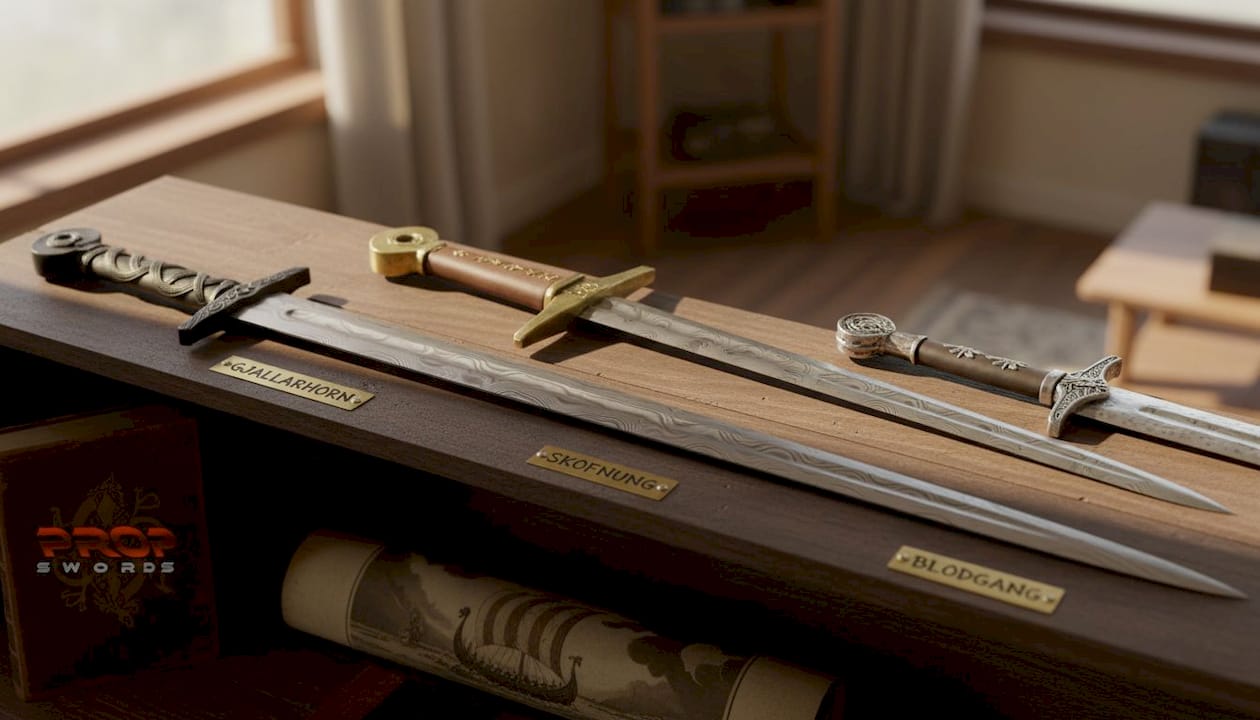
Pro Tip: Match your sword’s style to your collection theme. If you’re building a Norse mythology display, lean into runic details and ornate hilts. If historical accuracy is your goal, stick to documented Petersen type forms with period-correct materials.
Side-by-side comparison of top Viking sword replicas
To bring their features into focus, here’s how these standout designs stack up side by side.
| Design | Blade length | Material | Construction | Weight | Price range | Best use |
|---|---|---|---|---|---|---|
| Northman Damascus | 82 cm | Damascus steel | Pattern welded | 1.3 kg | High | Display/collection |
| Petersen Type D | 78 cm | High carbon steel | Monosteel | 1.1 kg | Budget/mid | Cosplay/stage combat |
| Ulfberht-inspired | 85 cm | High carbon steel | Monosteel | 1.2 kg | High | Display/thrusting demos |
| Fantasy runic sword | 76 cm | Stainless steel | Monosteel | 1.0 kg | Budget/mid | Cosplay/themed display |
| Dual-tone longsword | 90 cm | High carbon steel | Monosteel | 1.4 kg | Mid | Wall display/cosplay |
Historically, blades tapered more sharply after the 9th century to improve hilt balance, which is why monosteel replicas often handle better than pattern-welded versions despite being less visually complex.
The key takeaway from the table is this: Damascus steel wins on visual drama, monosteel wins on practicality, and stainless steel is the budget-friendly option that sacrifices some edge retention. No single design is perfect for every buyer.
When browsing top replica sword choices or considering using replica swords for costumes, ask yourself these three questions before you click purchase:
- Will I be carrying this sword for extended periods, or is it purely a wall piece?
- Does my local event or convention permit steel blades, or do I need a non-metallic option?
- Am I prioritizing visual authenticity or physical handling performance?
These questions cut through the noise faster than any spec sheet.
Choosing the right sword for your collection or cosplay
With all the options and data at your fingertips, here’s how to choose the design that’s perfect for you.
-
Define your primary purpose. Display swords can be heavier and sharper since no one will be swinging them. Cosplay swords need blunted edges, lighter weight, and sometimes non-metallic construction depending on event rules. Be honest with yourself here.
-
List your non-negotiables. Is historical accuracy the priority? You want pattern-welded steel and documented hilt forms. Is visual impact your goal? An ornate runic blade with a striking crossguard will turn more heads at a convention. Write these down before you browse.
-
Set a realistic budget. Quality Damascus replicas start around $150 and can exceed $400. Monosteel options run $60 to $200. Stainless or resin props can dip below $50 but often show it in the finish.
-
Consider weight and handling. Pattern welding combined flexibility and hardness by distributing impurities across folded iron and steel layers, which is why those blades feel different in hand compared to monosteel. For all-day wear at a convention, even a 200-gram difference matters significantly.
-
Check legal restrictions. Some states and event venues prohibit swords over a certain blade length or sharpness level. Confirm before you buy.
For more guidance, revisit the section on choosing a replica sword to cross-reference your needs against available options.
Pro Tip: For conventions, choose a replica with a removable or peace-tied scabbard. Event security appreciates it, and you’ll spend less time at the gate.
The most common collector mistakes include buying based on photos alone without checking weight specs, ignoring the steel type listed, and skipping the hilt comfort test entirely. A sword that looks perfect on screen but feels unbalanced in hand will sit in a closet within a month.
Why authenticity and safety matter equally in Viking sword replicas
Stepping back from individual designs, what truly defines a worthy Viking replica? Here’s our take.
The hobby has a tendency to split into two camps. Purists demand museum-accurate materials and documented typology. Cosplayers want something that looks good in photos and survives a weekend event. We think that divide is mostly unnecessary.
The best swords we’ve seen in serious collections are ones that respect historical aesthetics without becoming impractical. A display piece with a razor edge mounted at eye level is a liability, not a trophy. A cosplay sword so flimsy it bends when you draw it undermines the whole effect.
Modern metallurgy gives us tools the original Norse smiths never had. You can get the visual grain of pattern welding with the structural reliability of modern steel. That’s not cheating. That’s honoring the spirit of the craft while making it work in a contemporary context. The combining history with practicality approach produces pieces that people actually enjoy rather than just own.
A sword that inspires you every time you look at it and holds up to real-world use will always be worth more than a technically authentic piece gathering dust out of obligation.
Find your perfect Viking inspired sword at Propswords
If you’re ready to find an authentic, safe, and standout replica, here’s the best place to start.
Propswords carries a curated selection of Viking-inspired swords built for collectors and cosplayers alike. From hand-forged Damascus steel pieces with wooden scabbards to budget-friendly monosteel options that hold up through convention season, the range covers every tier and taste. Every sword is selected for visual detail, construction quality, and practical usability. Explore the full Viking sword collection and use the free USA shipping offer to bring your next display piece or cosplay centerpiece home without extra cost. Your wall, your costume, and your collection deserve a sword worth talking about.
Frequently asked questions
What makes a Viking inspired sword authentic for collectors?
Authentic Viking-inspired swords use historically accurate blade lengths, materials like pattern welded steel or monosteel, and feature documented hilt and fuller details drawn from archaeological finds.
Are Viking sword replicas safe for cosplay events?
Most reputable replicas use blunted edges and reinforced blades to meet event safety standards, with replicas balancing authenticity against durability so they hold up during active wear without posing a risk.
Which construction method is best for Viking replicas: pattern welding or monosteel?
Pattern welding delivers historical visual appeal, while monosteel post-9th century swords tapered more sharply for better balance and are the stronger choice for active handling or cosplay use.
What are common mistakes when buying Viking inspired swords?
The biggest errors are ignoring weight for handling, skipping edge treatment details, and overlooking how pattern welding and blade features affect both performance and authenticity in the final piece.