
Recent Post

Medieval Swords Explained: History, Design, and Real Use

Swords in martial arts: history, techniques & practice

Swords in Medieval Battle: Facts, Role & Impact

Why gift replica swords? Meaning, value & how to choose

How to buy anime swords online safely: 2026 guide

Why Choose Anime Swords? Collect, Cosplay, and Connect
Leave a comment
Medieval Swords Explained: History, Design, and Real Use
TL;DR:
- Medieval swords were precision-engineered tools, social symbols, and works of metallurgy.
- Proper combat techniques focused on control, leverage, and timing rather than brute force.
- Collecting authentic replicas requires attention to provenance, material quality, and historical accuracy.
Medieval swords are far more than the crude, heavy weapons Hollywood loves to portray. Pop culture has spent decades reducing one of history’s most thoughtfully designed weapons to a prop for chaotic, noisy fight scenes. The reality is something far more interesting. These blades were precision tools, social symbols, and masterworks of metallurgy that took skilled craftsmen years to perfect. This guide walks you through what a medieval sword actually is, how it was built, how fighters really used it, what it meant to the people who carried it, and how collectors today can appreciate it properly.
Table of Contents
- Defining the medieval sword: Parts and types
- How medieval swords were used in combat
- Symbolism and social role of the medieval sword
- Collecting and appreciating medieval swords today
- Why the reality of medieval swords matters more than their myths
- Where to start your medieval sword journey
- Frequently asked questions
Key Takeaways
| Point | Details |
|---|---|
| Advanced design | Medieval swords blend historical craftsmanship with practical fighting purpose. |
| Complex techniques | Combat required skillful technique, not just brute strength or wild swings. |
| Cultural significance | Swords symbolized status and were integral to medieval ceremonies and legend. |
| Collecting insight | Knowing historical facts helps collectors spot authenticity and appreciate value. |
Defining the medieval sword: Parts and types
Before anything else, you need to know what a medieval sword actually looks like under the surface. The sword anatomy explained breaks down into five key components that every enthusiast should recognize.
The five core parts of a medieval sword:
- Blade: The cutting and thrusting surface, ranging from wide and flat to narrow and stiff depending on era and purpose.
- Crossguard: The horizontal bar that protects the hand and can be used offensively in close grappling.
- Grip: Wrapped in leather or wire, shaped to fit the hand for control and endurance.
- Pommel: The weighted counterbalance at the base of the handle, critical for the sword’s overall balance point.
- Fuller: A shallow groove running along the blade that reduces weight without sacrificing structural strength.
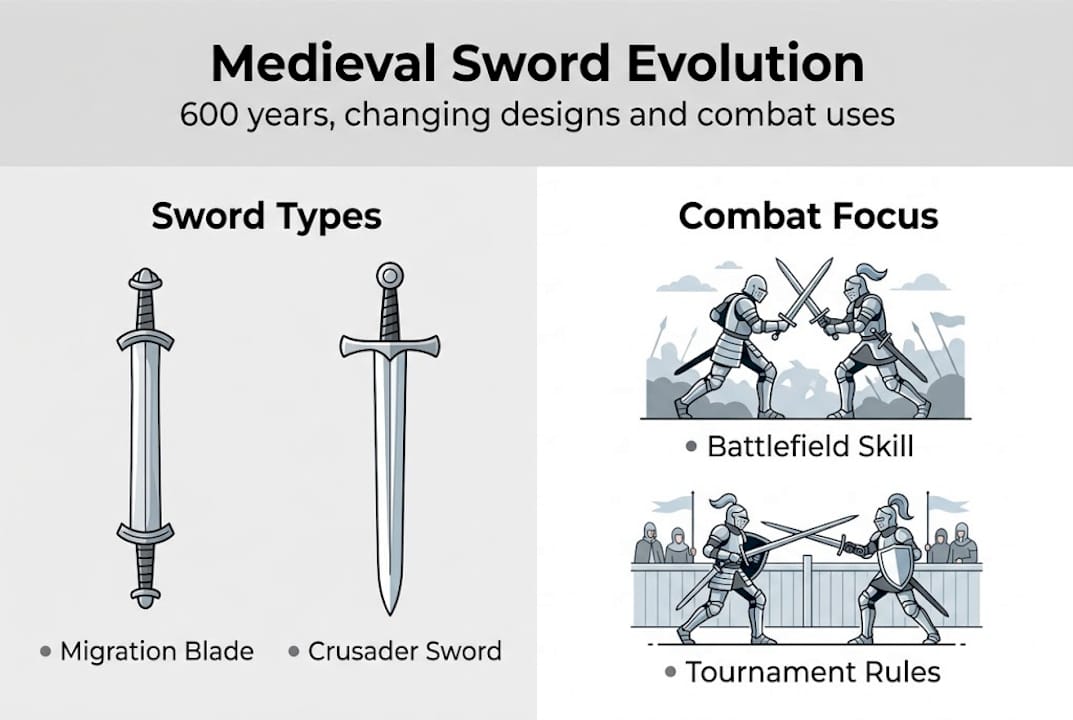
The evolution of medieval swords spans roughly 600 years and several distinct periods. Migration-era blades from the 5th and 6th centuries were wide, pattern-welded, and built for slashing cavalry. Viking-age swords from the 8th to 11th centuries refined those shapes with deeper fullers and more consistent steel. Carolingian swords bridged the gap, and High and Late Medieval swords grew longer, narrower, and more thrust-focused as armor improved.
| Period | Blade style | Primary purpose | Notable feature |
|---|---|---|---|
| Migration (5th-6th c.) | Wide, flat | Slashing | Pattern welding |
| Viking (8th-11th c.) | Broad, fuller | Cut and thrust | Single or double fuller |
| Carolingian (9th-10th c.) | Tapered | Cavalry use | Longer crossguard |
| High Medieval (11th-13th c.) | Narrowing | Battlefield | Improved steel quality |
| Late Medieval (14th-15th c.) | Stiff, acute | Armor penetration | Hexagonal cross-section |
One key metallurgical shift: pattern welding phased out after the 9th century as better homogeneous steel became available, and double fullers found in 8th to 12th century swords may be manufacturing artifacts or stylistic choices on high-status blades. That detail matters because it tells you a sword’s era and production quality at a glance, something every serious collector should internalize.
How medieval swords were used in combat
Here is where most people’s understanding falls apart completely. Medieval sword fighting was not random hacking. It was a highly codified system of technique, timing, and body mechanics that required years of dedicated training.
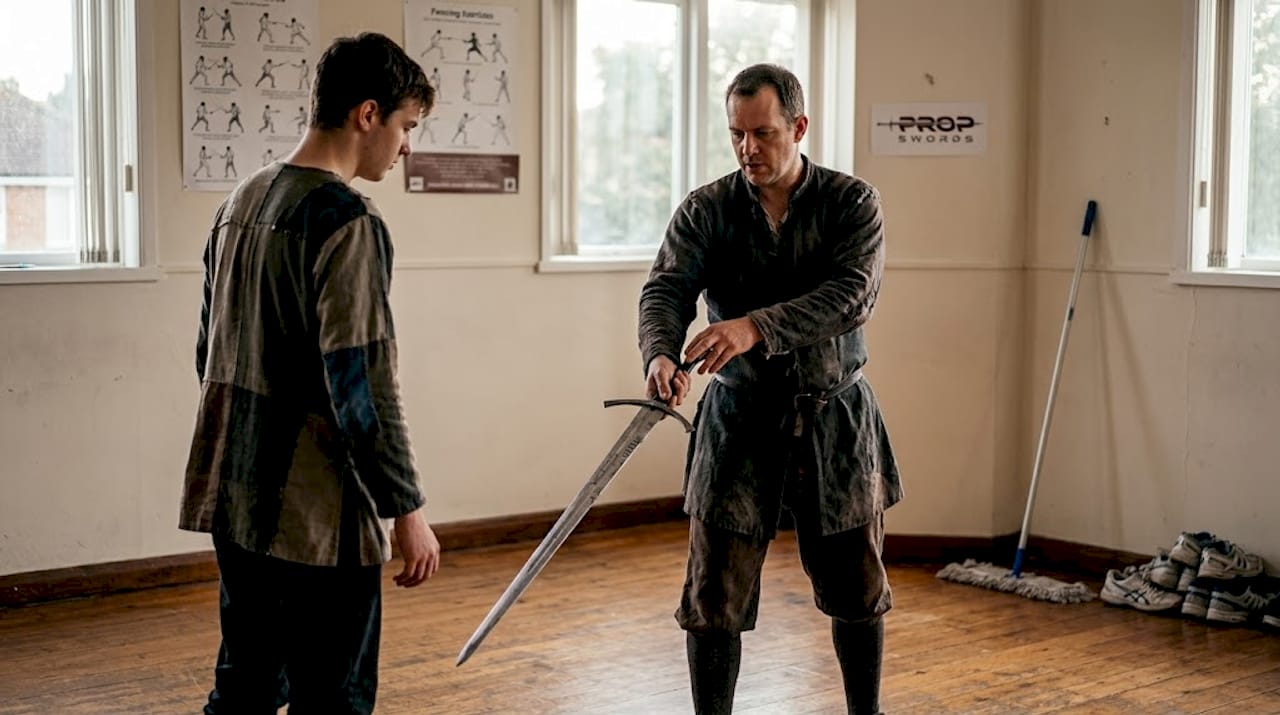
Historic longsword fighting techniques organized actions into three primary categories: cuts (Hauen), thrusts (Stechen), and grappling transitions. Fighters trained within structured guard positions and understood precise distance management, not unlike modern fencing or wrestling.
Four real techniques that challenge the Hollywood version:
- Half-swording: Gripping the blade with the off-hand to shorten leverage and drive the point through gaps in plate armor. This required control, not brute strength.
- Binding and winding: When blades meet, skilled fighters would feel pressure through the bind and rotate (wind) to gain a dominant angle for a follow-up attack.
- Pommel strikes: At close range, the weighted pommel became a striking tool targeting the face or helmet.
- Guards and stances: Named positions like Vom Tag, Ochs, and Pflug each controlled specific threat lines and set up specific counters.
“Combat was sophisticated: not wild hacking but positional fencing with binds, windings, and grappling.” — HEMA Longsword research
Battlefield use differed from tournament practice too. In tournaments, blunted swords and rules shaped technique. On an actual battlefield, fighters wore more armor and half-swording became far more common. You can read more about historical sword use and how modern reproductions reflect these realities.
Pro Tip: If you want to evaluate a replica’s historical accuracy, look at the blade’s cross-section. A diamond or lenticular profile reflects a real fighting blade optimized for stiffness and cutting geometry, not just appearance.
| Media version | Historical reality |
|---|---|
| Wild swinging, heavy blows | Controlled guards, timed attacks |
| Sword used only for cutting | Cuts, thrusts, pommel and guard strikes |
| Fighter relies on strength | Technique, leverage, and timing dominate |
| Armor makes sword useless | Half-swording targets weak points |
Symbolism and social role of the medieval sword
A sword was never just a tool. In medieval Europe, owning a quality sword meant something profound about who you were and where you stood in society.
What swords represented across medieval culture:
- Rank and authority: Only knights and nobility typically carried swords. Common soldiers used spears, axes, and knives.
- Oaths and ceremonies: Swords were placed on altars during oaths and laid across the shoulders in knighting rituals.
- Chivalric code: The sword became the physical embodiment of virtues like loyalty, courage, and justice.
- Trade value: A Viking sword cost 16 cows, and a Carolingian sword was valued at 7 solidi, roughly the price of several acres of farmland.
That economic reality explains a lot. These were not disposable weapons. Swords were inherited, named, gifted between lords, and sometimes buried with their owners. Named swords like Durendal and Joyeuse carried legendary status because the weapon was inseparable from the identity of its bearer.
“The sword was a symbol of justice and the Christian knight’s duty, a sacred object as much as a weapon.” — Medieval historian perspective on chivalric culture.
For collectors today, this symbolic weight still operates. A replica that honors replica sword status through correct proportions, period-accurate detailing, and quality materials carries a different kind of value than a generic fantasy blade. It connects you to something real.
The cultural importance of the sword also varied by region. Norse swords carried personal names and were thought to carry a warrior’s legacy. Frankish swords were luxury exports traded across Europe. Japanese and Islamic sword traditions developed parallel symbolisms independently, showing that this reverence for the blade was not unique to European culture but expressed universally.
Collecting and appreciating medieval swords today
The sword’s symbolism is not stuck in the past. It shapes how collectors evaluate, display, and invest in pieces today.
Material and authenticity remain the two biggest factors buyers consider when evaluating any historical sword or reproduction. Here is what a smart collector looks for.
Key criteria for evaluating a medieval sword:
- Provenance: Can the piece be traced to a specific maker, workshop, or historical source?
- Material quality: High-carbon steel, period-correct handle materials, and properly heat-treated blades signal serious craftsmanship.
- Geometry: Does the blade profile, taper, and cross-section match documented historical examples?
- Balance point: A well-made sword balances roughly 4 to 6 inches from the crossguard. Poor balance reveals a decorative piece, not a functional reproduction.
- Finishing: Look at the fuller, the edge geometry, and the grip wrap. Shortcuts here indicate lower production standards.
How to start a medieval sword collection:
- Research specific periods before buying. A Viking-age sword looks and functions differently from a 14th century knightly sword.
- Use a reliable sword collector checklist to evaluate any piece before purchase.
- Study sword replica craftsmanship standards so you can spot quality steel, proper heat treatment, and accurate geometry.
- Start with one strong period-accurate piece rather than accumulating generic display swords.
- Consider display as part of the experience. How a sword is mounted and presented affects how it reads in a collection.
Pro Tip: When choosing a medieval sword for your collection, handle it if possible. A properly balanced reproduction will feel alive in your hand, not front-heavy or awkward. That feeling is your best single quality indicator.
Authentic medieval swords that surface at auction regularly fetch tens of thousands of dollars. For most collectors, high-quality reproductions offer the best path to owning something that looks, feels, and balances like the real thing without requiring museum-level resources.
Why the reality of medieval swords matters more than their myths
We spend a lot of time in the sword world talking about what looks cool. The curved blade, the ornate crossguard, the dramatic length. But after years of working with historical weaponry and speaking with serious collectors, we have a different take.
The most interesting thing about a medieval sword is not how it looks. It is how completely it reflects the intelligence of the people who made and used it. Every design decision, from the fuller reducing blade weight to the pommel counterbalancing the blade, solved a real problem under real pressure. That is engineering, not decoration.
Media keeps selling us historical vs fantasy swords as though fantasy is inherently more appealing. We disagree. The real history is stranger, more refined, and more dramatic than anything a screenwriter invents. A fighter half-swording a plate-armored knight while managing three distance zones and reading blade pressure is more technically impressive than any CGI duel.
Collectors who understand this see more value in their pieces. They ask better questions, spot better craftsmanship, and build collections that hold meaning over time. The myth is entertaining. The reality is genuinely extraordinary.
Where to start your medieval sword journey
If this has sparked something in you, the next step is finding pieces worth your time and money. Not every sword on the market is built with the historical accuracy and material integrity that real collectors deserve.
At Propswords, we curate replicas built with attention to the details that matter: correct geometry, quality steel, period-accurate styling, and a balance that honors the original weapon’s function. Whether you are building your first collection, adding a display centerpiece, or exploring Viking, Carolingian, or knightly sword styles, our catalog makes it easy to find the right piece. We offer free shipping within the USA and ongoing promotions that make collecting more accessible than ever. Let real history drive what hangs on your wall.
Frequently asked questions
What distinguishes a medieval sword from other types of swords?
A medieval sword is typically a double-edged blade with a crossguard, designed for both cutting and thrusting, and was used throughout Europe from roughly the 9th to the 15th century. Its defining feature is the integration of balance, geometry, and versatility into a single weapon platform.
How were medieval swords made?
Pattern-welded steel defined early medieval swords, but later production shifted to improved homogeneous steel with fullers added for strength and weight reduction. The progression shows increasing metallurgical sophistication over several centuries.
Were medieval swords heavy?
Most authentic medieval swords weighed between 2.5 and 4 pounds, making them well-balanced and manageable for trained fighters rather than the unwieldy weapons movies suggest.
Why did swords symbolize nobility and knighthood?
Because swords were expensive and central to rituals like the knighting ceremony, they became the definitive symbol of chivalric rank and moral authority in medieval European culture.
Can you collect authentic medieval swords today?
Genuine examples are rare and expensive at auction, but accurate replicas offer collectors a practical and visually compelling alternative that honors the historical original in design, material, and proportion.