
Recent Post

Swords in martial arts: history, techniques & practice

Swords in Medieval Battle: Facts, Role & Impact

Why gift replica swords? Meaning, value & how to choose

How to buy anime swords online safely: 2026 guide

Why Choose Anime Swords? Collect, Cosplay, and Connect

Top benefits of replica swords for collectors and cosplay
Leave a comment
Swords in martial arts: history, techniques & practice
TL;DR:
- Swords are living tools that shape martial arts, tradition, and culture today.
- Mastery requires understanding historical context, technical skill, and philosophical differences.
- Modern training uses safe simulators, competitions, and deep appreciation for sword history.
Swords are not museum pieces gathering dust behind velvet ropes. They are living tools, still shaping how martial artists think, move, and train today. The moment you dismiss them as decorative relics or props, you miss a tradition that has driven human conflict, culture, and philosophy for thousands of years. This guide walks through the full picture: where sword-based martial arts came from, what it actually takes to master the blade, how Eastern and Western traditions diverge in fascinating ways, and why collecting a sword without understanding its context is only half the experience.
Table of Contents
- From battlefield to dojo: evolution of swords in martial arts
- Technical mastery: signature techniques in sword-based martial arts
- Principles and philosophies: contrasting Eastern and Western sword arts
- Modern practices: swords in training, competition, and collecting today
- Behind the blade: what modern martial artists and collectors often miss
- Explore, equip, and elevate your sword journey
- Frequently asked questions
Key Takeaways
| Point | Details |
|---|---|
| Swords evolve with martial arts | From battlefield dominance to modern dojos, swords adapt functionally and symbolically in martial traditions. |
| Distinctive techniques shape practice | Technical mastery in sword arts relies on precise methods like Meisterhauen or hasuji, with unique training approaches. |
| Philosophy drives style | Eastern and Western sword arts differ in principles, with each culture shaping its martial intent and rituals. |
| Modern adaptation keeps swords relevant | Contemporary training, competitions, and collecting ensure swords remain an active part of the martial arts world. |
From battlefield to dojo: evolution of swords in martial arts
For most of human history, the sword was the ultimate personal weapon. It demanded physical conditioning, refined motor skill, and years of dedicated practice. But swords were never just tools of violence. From the earliest days of the Roman legions to the peak of the samurai era, they carried social weight that no other weapon matched.
European swordsmanship produced a lineage of blade designs, each adapted to the battlefield realities of its era: the gladius for close-quarters legion combat, the arming sword for knightly duels, and the longsword for the armored chaos of medieval warfare. In Japan, the katana became the soul of the samurai class, codified into kenjutsu as a complete system of movement and mindset. Swords served as primary weapons that evolved from battlefield tools into symbols of status across both continents.
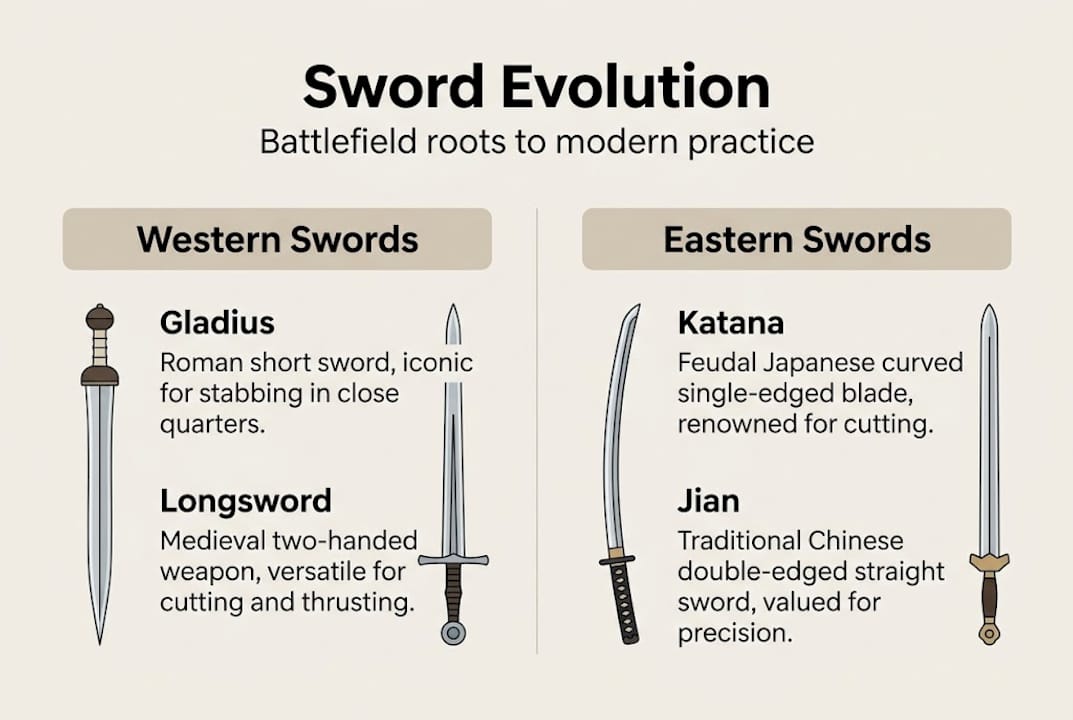
What made the transition from war to dojo possible was codification. Martial traditions began writing down techniques, creating schools, and systematizing what had been improvised survival knowledge. A historical sword reproduction guide reveals just how much blade geometry changed as swords shifted from battlefield necessity to training artifact, affecting everything from weight distribution to grip design.
| Region | Sword type | Martial tradition |
|---|---|---|
| Europe | Longsword | HEMA (Historical European Martial Arts) |
| Japan | Katana | Kenjutsu, Iaido |
| Europe | Arming sword | Medieval tournament fighting |
| Japan | Wakizashi | Niten Ichi-ryu (two-sword style) |
Here are the key stages of that evolution:
- Battlefield tool: Swords were optimized purely for killing efficiency in war.
- Status symbol: Noble and warrior classes adopted swords as markers of rank.
- Training system: Codified schools preserved techniques as the battlefield faded.
- Cultural artifact: Swords became tied to national identity, ceremony, and art.
“The sword is the soul of the samurai.” This phrase, attributed to Japanese tradition, captures why disarming a samurai was not just tactical. It was a moral act.
For collectors, understanding these historical layers matters. The difference between historical sword replicas is not just weight and length. It is what each design communicates about the era it came from. And reenactment roles of swords show how that history gets actively preserved today through living practice rather than passive display.
Technical mastery: signature techniques in sword-based martial arts
Having traced how swords became martial icons, we now explore what it takes to wield them with true technical skill.
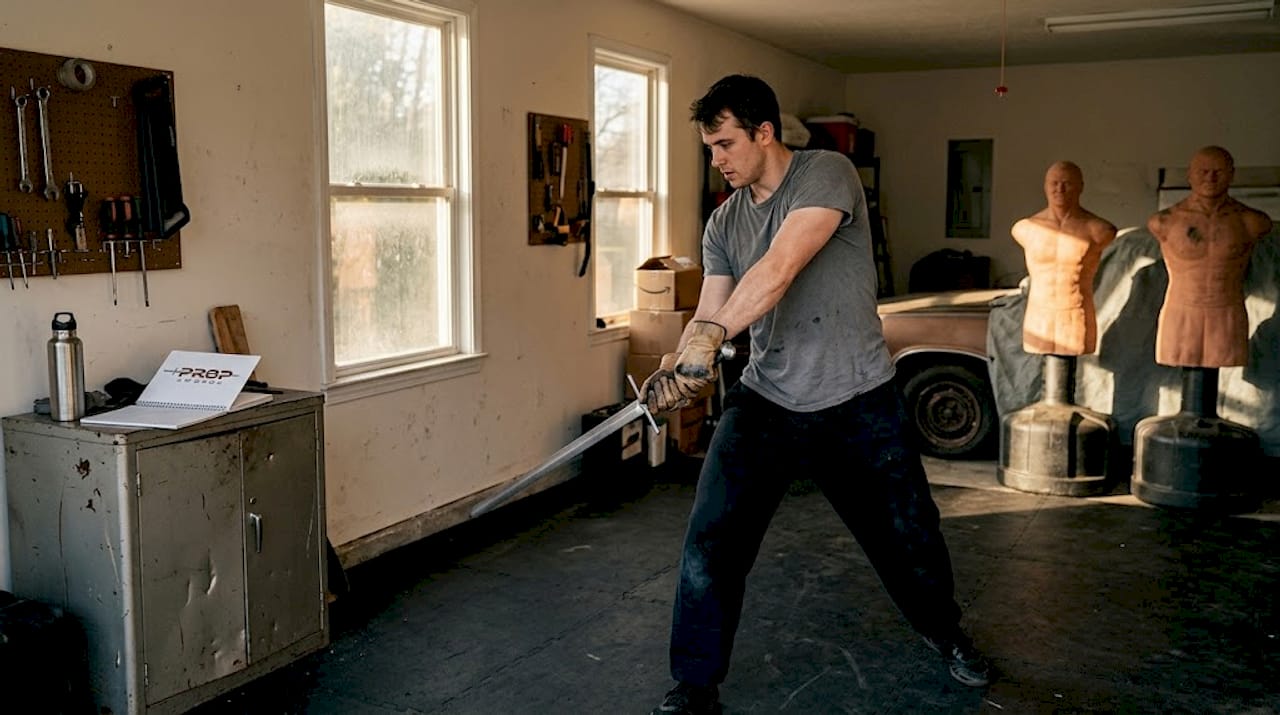
In HEMA, the longsword tradition built around Johannes Liechtenauer is one of the richest surviving systems of sword combat. At its core are five Meisterhauen, or master strikes, each designed to defeat a specific guard position or counter a specific attack. HEMA longsword techniques from the Liechtenauer tradition include cuts, thrusts, half-swording, and grappling executed from guards like Vom Tag and Ochs. These are not flashy moves. They are tactical responses to real threats.
Japanese sword arts take a different path but require equal discipline. In kenjutsu and iaido, hasuji (edge alignment) is the central concept. If your blade is even slightly off-angle when it contacts a target, the cut fails. Tameshigiri, the practice of test cutting through rolled tatami mats, exposes mechanical flaws instantly and without mercy.
Key Japanese cutting techniques by difficulty:
- Kesa-giri (diagonal cut, downward): Considered the most accessible cut for beginners due to natural arm mechanics.
- Yoko-giri (horizontal cut): Much harder to execute cleanly because the wrist must rotate while maintaining edge alignment.
- Hasuji drills (edge alignment practice): Foundational but never truly mastered, requiring continuous refinement.
| Technique | Origin | Skill focus |
|---|---|---|
| Zornhau | HEMA (German) | Countering high guards |
| Kesa-giri | Kenjutsu | Diagonal cutting path |
| Zwerchhau | HEMA (German) | Cutting around armor |
| Tameshigiri | Iaido/Kenjutsu | Test cutting mechanics |
Pro Tip: Edge alignment is not just a beginner’s problem. Even advanced practitioners expose hasuji gaps when they speed up or switch to unfamiliar targets. Slowing down and using a mirror or video review catches issues that feel invisible in real time.
For anyone serious about training with functional tools, exploring training swords for HEMA gives you a sense of what authentic blade geometry feels like in the hand. Pairing that with quality sword accessories for practice rounds out a complete training setup.
Principles and philosophies: contrasting Eastern and Western sword arts
With foundational techniques in mind, let’s examine what truly differentiates sword martial arts from East to West.
The clearest divide is between principle-based and form-based instruction. HEMA, particularly the German and Italian schools, teaches a set of underlying principles (such as the concept of Vor and Nach, meaning before and after in terms of initiative) that practitioners then apply flexibly. The student learns to read situations and adapt. Japanese systems, by contrast, rely heavily on kata: fixed sequences practiced thousands of times until the body responds without thought.
HEMA prioritizes armored combat versatility, incorporating grappling, thrusts into gaps in armor, and blade binding, while Japanese arts are calibrated for unarmored opponents where a single precise cut decides everything. This difference is not philosophical preference. It reflects real battlefield conditions. European knights fought in full plate, so grappling and half-swording were survival skills. Japanese duels and battlefield engagements often involved lighter armor, favoring speed and cutting precision.
Culturally, the contrasts run just as deep:
- Hierarchy: Japanese kendo has a rigidly structured ranking culture with formalized etiquette. Many Western HEMA clubs are comparatively informal and horizontal in structure.
- Competition: Kendo has a centuries-old competition culture with highly standardized rules. HEMA tournaments are still developing unified rulesets.
- Source material: HEMA practitioners reconstruct techniques from medieval fight manuals (Fechtbücher). Japanese arts pass techniques through direct lineage from master to student.
- Goal: Kendo emphasizes competition and spirit development, with a uniquely hierarchical structure in Japan compared to more egalitarian approaches in international clubs.
Pro Tip: Most people think historical duels were ceremonial affairs with agreed-upon rules. They were not. The majority of sword traditions trained for survival, not sport. That reality changes how you interpret every technique.
Understanding these contrasts deepens your appreciation for what makes each tradition unique. Exploring the sword legacy in martial arts through authentic replicas and reproduction guides gives collectors a tangible way to connect with these philosophical differences.
Modern practices: swords in training, competition, and collecting today
Understanding principles is key. Now see how ancient traditions shape evolving practices, tournaments, and collecting values in 2026.
Modern sword training has solved a problem that plagued historical practitioners: how do you train realistically without killing your training partner? The answer varies by tradition. HEMA uses feder simulators for sparring. Kendo uses shinai (bamboo swords) and bogu (protective armor). Iaido focuses on solo kata with iaito, unsharpened training swords designed to replicate the weight and feel of a live blade.
Modern sword training tools by discipline:
- Feder (HEMA): Flexible steel simulator for full-contact sparring with minimal injury risk.
- Shinai (Kendo): Bamboo sword for competitive striking practice.
- Iaito (Iaido): Unsharpened metal sword for solo kata training.
- Bokken (multiple arts): Wooden sword for basic partner drills and kata.
| Tool | Art | Primary use |
|---|---|---|
| Feder | HEMA | Full-contact sparring |
| Shinai | Kendo | Competitive striking |
| Iaito | Iaido | Solo kata practice |
| Tatami mat | Tameshigiri | Test cutting target |
Stat callout: Kendo counts over 2 million active practitioners in Japan alone as of 2025, making it one of the most widely practiced sword-based martial arts on Earth.
Competitions like the Swordfish tournament in Sweden draw HEMA fighters from across Europe and beyond. Kendo tournaments operate under the All Japan Kendo Federation with nationally standardized rules. Tameshigiri competitions judge the quality, angle, and number of cuts, providing an objective measure of technical skill that no amount of kata can fake.
For collectors, this modern landscape matters. A sword displayed on a wall tells one story. A sword understood in context tells another entirely. Learning about safe sword display tips and displaying swords at home helps bridge the gap between owning something beautiful and truly honoring what it represents.
Behind the blade: what modern martial artists and collectors often miss
Most people approach swords from one of two angles: pure sport or pure aesthetics. Both miss something important.
The practitioner who treats sword training as a sport metric chases tournament points without understanding why techniques were designed the way they were. When blade binding in HEMA leads unexpectedly into grappling, or when a tameshigiri attempt reveals poor hasuji through a deflected cut, the gap between trained movement and real understanding becomes obvious fast.
The collector who buys a blade purely for display misses the other half. Every curve of a katana, every fuller on a longsword, exists because someone needed it to work under extreme pressure. That context transforms a decorative object into a historical document.
The uncomfortable truth is that swords demand contextual knowledge. Techniques only come alive through disciplined, purposeful practice informed by historical understanding. And collections only gain real depth when the collector knows the story behind each piece. We think the best martial artists we have encountered are also serious students of history, and the best collectors we know practice at least the basics of the arts their blades represent. Those two worlds are not separate. They reinforce each other.
For anyone building a serious collection, exploring displaying sword collections with full historical context is the natural next step.
Explore, equip, and elevate your sword journey
You now have a foundation most sword enthusiasts never build: historical context, technical understanding, philosophical contrast, and a clear view of modern practice. The question is what you do with it.
At Propswords, we bring together sword resources and collectibles that match the seriousness of your interest. Whether you are after a high-quality replica inspired by a historical tradition, a display-worthy piece that honors the craft, or simply a starting point for deeper exploration, our catalog is built for people who actually care about what swords mean. Free shipping within the USA makes it easier to start or expand your collection today. Browse, explore, and find the blade that fits your journey.
Frequently asked questions
What is the hardest sword cut to master in Japanese martial arts?
The horizontal cut (yoko-giri) is widely considered the most difficult because maintaining edge alignment while rotating the wrist through a full horizontal plane demands a level of control that takes years to develop.
How do sword techniques in HEMA differ from Japanese sword arts?
HEMA emphasizes armored combat versatility with grappling and thrusting, while Japanese sword arts focus on precise slicing techniques calibrated for unarmored opponents where a single clean cut is decisive.
Are modern martial artists still tested with real swords?
Some traditional Japanese schools still use real blade cutting in tameshigiri practice, but most modern training relies on safe simulators like the feder, shinai, and iaito to allow full-intensity practice without serious injury risk.
How popular is kendo today?
Kendo has over 2 million practitioners in Japan as of 2025, cementing its place as one of the most widely practiced sword-based martial arts in the world today.