Recent Post

Role of Swords in Cosplay: Enhancing Realism and Impact

6 Iconic Examples of Movie Swords for Collectors

6 Essential Types of Cosplay Swords for Accurate Costumes

Why Display Swords: Enhancing Collections and Space

Fantasy Swords vs Historical Swords: What Collectors Need to Know

Movie Sword Replicas Explained: Quality, Types, and Safety
Leave a comment
Role of Swords in Cosplay: Enhancing Realism and Impact
Every cosplayer knows the excitement of finding a sword that perfectly matches their favorite anime or movie hero. For passionate fans across North America, the quest for the right sword is about more than finishing a costume—it is a way to show real love for the character and the story. Choosing the right replica makes your cosplay unforgettable by blending visual accuracy, durability, and safety for conventions, turning a simple prop into an essential part of your performance.
Table of Contents
- Role of Swords in Cosplay Culture
- Types and Materials of Cosplay Swords
- Choosing Accurate Replicas for Characters
- Safety, Convention Rules, and Legal Risks
- Common Mistakes in Cosplay Sword Use
Key Takeaways
| Point | Details |
|---|---|
| Importance of Swords | Swords enhance character authenticity in cosplay, acting as critical identifiers for characters and impacting how you embody them. |
| Material Selection | The right sword material affects comfort, durability, and appearance; beginners should start with EVA foam for ease of construction. |
| Research and Accuracy | Thorough research on a character’s weapon is vital to ensure visually appealing and accurate cosplay swords, improving overall representation. |
| Convention Compliance | Familiarize yourself with convention safety policies regarding props to avoid mishaps and ensure a positive experience during events. |
Role of Swords in Cosplay Culture
Swords have become central to cosplay identity, transforming from simple costume pieces into powerful tools for character authenticity. They’re not just accessories—they’re statements about commitment to your craft.
Cosplay emerged from a blend of costume and play, and props like swords deeply embody affection for anime and manga characters. This isn’t accidental. When you hold a replica sword that matches your character’s weapon, something shifts. The character feels real. You feel real.
The culture around swords in cosplay has evolved significantly over the past decade. What started as DIY foam weapons has transformed into a thriving ecosystem of replica craftspeople and collectors who understand the nuances of character authenticity.
Why Swords Matter in Cosplay Identity
Swords carry narrative weight. They define characters across anime, manga, movies, and games. Think about how different Ichigo’s sword feels from Tanjiro’s, or how a Viking warrior’s blade differs from a fantasy elf’s. These distinctions matter to your portrayal.
A quality sword prop tells convention judges and fellow cosplayers that you understand your character at a deeper level. It shows you’ve researched the source material and invested in accuracy.
Key reasons swords amplify cosplay impact:
- Instantly communicate character identity to observers
- Create visual balance and silhouette accuracy
- Enable dynamic posing and photography opportunities
- Demonstrate commitment to your costume’s authenticity
- Serve as conversation starters with other fans
Community and Peer Learning
Cosplay thrives as a peer-based DIY community where creators learn from one another. Sword selection is no exception. At conventions, you’ll find experienced cosplayers sharing knowledge about weight distribution, material choices, and display techniques.
This collective knowledge shapes how the community approaches weaponry. Veterans mentor newcomers on everything from transportation safety to photography angles that highlight your sword’s details.
From Display to Performance
Your sword isn’t just costume decoration—it influences how you embody your character. A properly weighted replica changes your posture, your movement, your presence. Cosplayers often report that holding an accurate sword makes them feel more connected to the character they’re portraying.
Conventions and photoshoots become immersive experiences when your props match your character’s canon specifications. The authenticity creates psychological investment that elevates your entire performance.
A sword connects you to your character’s story in ways other costume elements simply cannot replicate.
Pro tip: Before selecting your sword, research your character’s weapon from multiple angles in source material—official art, anime/movie screenshots, and fan documentation—to understand not just appearance but how the character wields it.
Types and Materials of Cosplay Swords
Your sword material choice shapes everything about your cosplay experience. The right material balances appearance, durability, and how it feels in your hands during a 12-hour convention day.
Cosplay swords are constructed from a range of materials prioritizing balance between appearance, durability, and manageability. No single material dominates—each serves different needs based on your skill level, character, and event requirements.
Common Sword Materials and Their Strengths
EVA foam remains the most beginner-friendly option. It’s lightweight, forgiving to shape, and safe for convention floors. You can carve details directly into it, making it perfect for your first sword build.
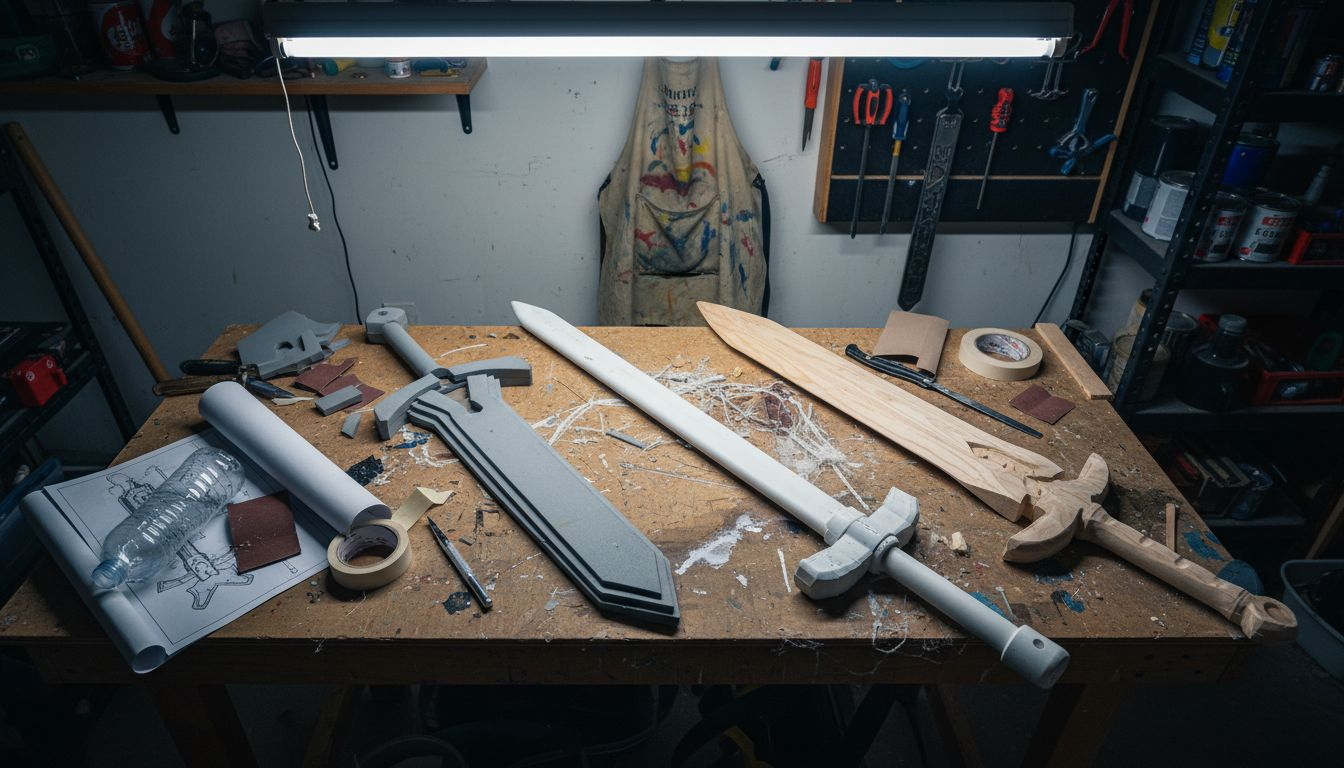
Worbla thermoplastic offers superior detail work. This material hardens when cooled, holding intricate sculpting and surface details that EVA foam struggles to maintain. Experienced builders favor it for high-realism props.
PVC pipes provide structure and strength. Many cosplayers use PVC as a core with foam covering, creating weapons that feel substantial without excessive weight.
Wood and resin deliver authentic appearance. Wood swords carry genuine heft and look incredibly realistic in photos. Resin allows for smooth, polished surfaces that catch light beautifully.
Lightweight metals give professional-grade results. Aluminum and blunt steel create convention-safe weapons that look entirely authentic. They demand experience but reward you with museum-quality props.
Here’s a quick guide to matching cosplay sword materials to user experience and event needs:
| Material | Best For | Drawbacks | Ideal Event Type |
|---|---|---|---|
| EVA Foam | Beginners, safety | Lower durability | Large conventions |
| Worbla | Detailed realism | More expensive | Photoshoots, contests |
| PVC + Foam | Easy builds, structure | Limited high-detail finish | General cosplay usage |
| Wood/Resin | Realistic look | Heavier, harder to fix | Convention displays |
| Metal (Aluminum) | Advanced cosplayers | Convention restrictions | Professional competitions |
Choosing Your Material
Consider these factors when selecting:
- Your experience level: EVA foam for beginners, Worbla for intermediate, metals for advanced
- Character authenticity: Medieval knights need different materials than anime sword-wielders
- Convention policies: Check weapon restrictions before committing to heavy materials
- Transportation: Foam travels easier than metal across airports and parking lots
- Durability needs: How many events will this sword attend before retirement?
Material Comparison at a Glance
| Material | Weight | Detail Level | Durability | Learning Curve |
|---|---|---|---|---|
| EVA Foam | Very Light | Moderate | Fair | Easy |
| Worbla | Light | Excellent | Good | Moderate |
| PVC Pipe | Moderate | Low | Excellent | Easy |
| Wood | Heavy | High | Excellent | Moderate |
| Metal | Heavy | High | Excellent | Hard |
Material choice isn’t about picking the “best” option—it’s about matching your sword to your specific cosplay goals and constraints.
Pro tip: Start with EVA foam for your first sword to learn fundamental construction and design, then upgrade to premium materials once you understand what details matter most for your character’s authenticity.
Choosing Accurate Replicas for Characters
Picking the right sword replica separates good cosplays from unforgettable ones. Your choice directly impacts how convincingly you embody your character and whether your costume passes the critical eye of convention judges.
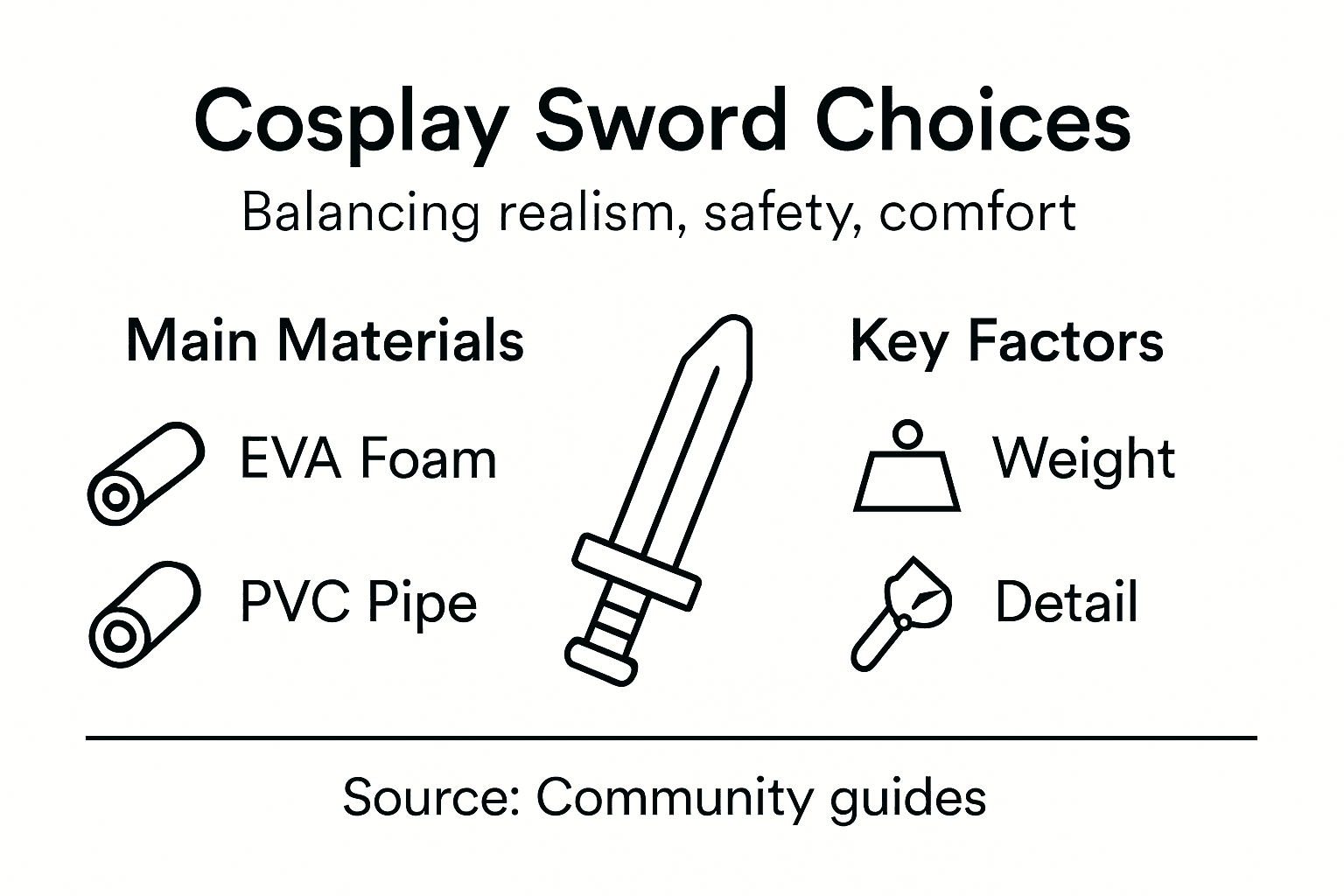
Choosing accurate replicas requires careful selection of high-quality materials that balance durability and visual authenticity. This means researching your character’s weapon thoroughly before committing to a purchase.
Research Your Character’s Weaponry
Start by gathering reference images from multiple sources. Watch anime episodes or movies where your character uses their sword. Look for official character designs, promotional art, and fan documentation that shows weapon details from different angles.
Pay attention to:
- Blade shape and curvature (straight, curved, jagged)
- Guard design and ornamental details
- Handle wrapping and grip style
- Overall proportions and length relative to the character
- Color schemes and metallic finishes
- Any unique markings or symbols
This research prevents costly mistakes like purchasing a sword that’s slightly wrong in the source material.
Evaluate Design Features and Quality
Once you’ve identified your target sword, examine the seller’s product photos critically. Look for accurate proportions, appropriate material finishes, and attention to small details that distinguish replica quality.
Check these specific elements:
- Sharp edges properly dulled for safety
- Clean welds and seamless joins
- Accurate paint application and weathering
- Proper handle wrapping and grip comfort
- Weight distribution that feels natural in your hands
Assess Durability and Safety Standards
Your sword needs to survive a full convention day plus photography sessions. Convention safety rules prohibit actually sharp blades, so verify that your replica meets those standards.
Consider the intended use:
- Display only: Can prioritize aesthetics over durability
- Convention wear: Needs robust construction and padded edges
- Action photography: Requires reliable weight distribution and secure fittings
- Multiple events: Demands premium materials and craftsmanship
Verify Size and Weight Comfort
Measure your character’s sword proportions against your own frame. A replica that’s proportionally perfect might feel awkward if you’re significantly different in height than the character.
Test weight expectations before purchasing. Ask sellers about exact specifications—most quality replicas specify weight in ounces or pounds. Hold similar weighted objects to understand the feel.
Accurate replicas aren’t just about matching appearance; they’re about matching your character’s weapon to your body and the event’s requirements.
Find Reputable Sellers
Look for sellers with detailed product photos, clear material specifications, and genuine customer reviews. Avoid sellers with vague descriptions or stock images that might not represent actual quality.
Pro tip: Before purchasing, contact the seller with your character reference images to confirm their replica matches your source material—a quick conversation prevents ordering the wrong design variant.
Safety, Convention Rules, and Legal Risks
Your sword replica sits at the intersection of costume authenticity and serious responsibility. Convention safety policies exist because props can cause real harm if mishandled, and legal consequences extend beyond event removal.
Understand that convention safety policies for cosplay swords require inspection and approval, typically enforcing lightweight, non-hazardous materials without sharp edges. These rules protect attendees and protect you from legal liability.
Convention Weapon Inspection and Peace-Bonding
Most conventions require your sword to pass an official inspection before you can wear it on the floor. Inspectors check for sharp edges, structural integrity, and material safety. Once approved, your prop receives a peace-binding mark—usually tape or a tag that proves you’ve cleared safety checks.
Never remove peace-bonding marks. Doing so violates convention policy and can result in immediate removal from the event or law enforcement involvement.
Material and Design Requirements
Conventions enforce strict material standards for obvious reasons. Your sword cannot have genuinely sharp edges, functional moving parts, or realistic projectiles.
Approved materials typically include:
- EVA foam with dulled edges
- Resin with rounded surfaces
- Lightweight thermoplastics
- Wood without exposed sharp points
- Blunted aluminum or steel
Prohibited elements:
- Actual metal blades or sharp edges
- Functional mechanisms
- Anything resembling real weapons too closely
Handling Rules on Convention Floors
Your sword might be approved, but your behavior with it matters equally. Convention cosplay prop regulations emphasize keeping props secured and avoiding swinging or hitting motions, respecting social norms around weapon handling.
This means:
- Keep your sword secured in a sheath or strap when moving through crowded areas
- Never swing it as a joke or to show off
- Avoid pointing it directly at people, even playfully
- Be aware of crowds and tight spaces
- Store it safely when not wearing your costume
Legal Risks Beyond Convention Walls
Convention rules are just one layer. Local weapons laws vary significantly across North America. Some jurisdictions prohibit carrying realistic-looking swords in public, regardless of safety.
Transporting your sword off-site requires caution. Pack it securely, keep it covered, and avoid carrying it through airports or public spaces unnecessarily. Law enforcement might stop you if a realistic-looking sword is visible.
Violations and Consequences
Convention violations escalate quickly. First offenses typically result in prop confiscation and removal from the event. Repeated violations or dangerous handling can involve law enforcement and permanent bans from conventions.
Safety violations aren’t minor infractions—they’re decisions that can end your cosplay season and damage the community’s reputation with event organizers.
Pro tip: Contact your specific convention’s safety team before the event with photos of your sword to get preliminary approval, saving time at check-in and preventing last-minute surprises.
Common Mistakes in Cosplay Sword Use
Even experienced cosplayers stumble when it comes to sword props. The most damaging mistakes aren’t dramatic—they’re subtle oversights that compromise safety, realism, or your convention experience.
Common mistakes with cosplay swords include neglecting safety precautions and using overly heavy materials, which can undermine realism or cause injury. Understanding these pitfalls helps you avoid expensive corrections and costume disasters.
Choosing the Wrong Weight and Materials
Many cosplayers prioritize appearance over functionality. They select materials that look perfect but feel impossible to hold for hours at a convention.
A sword that’s too heavy causes shoulder strain, awkward posture, and visible fatigue in photos. Your character wouldn’t stand hunched over from weapon weight—neither should you. Test weight before purchasing by holding similarly weighted objects for extended periods.
Weight reality check:
- Under 2 lbs: Comfortable for all-day wear
- 2-4 lbs: Manageable but noticeable by hour eight
- Over 4 lbs: Requires exceptional conditioning or frequent breaks
Ignoring Transportation and Storage
You’ve built an amazing sword. Then you try fitting it in your car for the drive to the convention. Reality hits hard.
Forgetting to consider transportability means your beautiful prop might not survive the journey intact. Plan your packing strategy before construction starts. Oversized swords require special cases, padded storage, and careful vehicle arrangement.
Measure your transport space and design your sword to fit reality, not fantasy.
Skipping Character Weapon Research
You assume you know what your character’s sword looks like. You’ve watched the anime twice. Wrong. Mistakes often involve neglecting to research the character’s weapon for accuracy, which undermines your entire portrayal.
Screen grabs don’t show every detail. Official character sheets reveal proportions you missed. Fan wikis compile obscure weapon specifications. Invest time researching before ordering or building.
Neglecting Balance and Weight Distribution
A sword can look perfect but feel completely wrong in your hands. Poor balance makes it uncomfortable to hold and nearly impossible to pose dynamically for photos.
Balance matters for:
- Comfortable hand positioning
- Natural posing in photographs
- Extended wear without hand fatigue
- Authentic character movement
- Confidence while handling the prop
Skipping Maintenance and Durability Planning
Your sword survives convention day one. Convention day two, paint chips. By convention day three, the handle is falling apart.
Lack of maintenance planning means your investment degrades rapidly. Plan protective coatings, handle reinforcement, and storage conditions before the first event. Quality upkeep extends your sword’s lifespan through multiple conventions.
Here’s a summary of common cosplay sword mistakes and their prevention tips:
| Mistake | Impact on Cosplay | Prevention Strategy |
|---|---|---|
| Sword too heavy | Fatigue, loss of realism | Test weight, choose lighter material |
| Poor transport planning | Prop damage, travel issue | Measure car/storage before building |
| Incomplete weapon research | Inaccurate appearance | Use official art/fan docs |
| Balance neglected | Awkward posing, discomfort | Check hand position, test balance |
| No maintenance plan | Short lifespan, damage | Reinforce handle, apply coatings |
The difference between a sword that lasts one convention and one that lasts five is simple preparation and maintenance from day one.
Pro tip: Build a test checklist two weeks before your first event: test weight for eight-hour comfort, measure your transportation space, verify convention prop policies, and do a final appearance check against source material.
Elevate Your Cosplay with Authentic Replica Swords
Cosplayers understand how crucial an accurate sword prop is for bringing a character to life. The article highlights challenges like selecting the right material, achieving balanced weight, and matching your sword to your character’s unique design. These pain points can make or break your cosplay experience, impacting everything from posing to convention safety compliance. At Propswords, we specialize in providing high-quality swords inspired by anime, movies, and historical weaponry that meet these exact needs.
Discover our wide selection to find the perfect sword that captures your character’s essence while offering durability and comfort. Whether you are a beginner seeking lightweight options or a seasoned cosplayer wanting premium replicas, Propswords is your trusted partner for authenticity and impact. Start browsing our collection today and take your cosplay to the next level with swords designed for both realism and ease of use. Visit our landing page now to explore and enjoy promotions like free USA shipping and exclusive discounts.
Frequently Asked Questions
What materials are commonly used for cosplay swords?
Common materials for cosplay swords include EVA foam for beginners, Worbla thermoplastic for detailed realism, PVC pipes for structure, wood and resin for realistic appearance, and lightweight metals like aluminum for professional-grade results.
How does the weight of a sword affect cosplay?
The weight of a sword can impact your comfort and representation of the character. Swords under 2 lbs are comfortable for all-day wear, while swords over 4 lbs can lead to fatigue and affect posing.
What tips can help ensure my cosplay sword is safe for conventions?
To ensure safety, use materials with dulled edges, pass convention inspections, and keep your sword secured in a sheath during movement. Familiarize yourself with the specific weapon rules of your convention.
Why is character weapon research important for cosplay swords?
Researching your character’s weapon is crucial for achieving accuracy in appearance and proportions. It helps you understand specific details like blade shape, guard design, and overall aesthetics, enhancing your cosplay’s authenticity.