
Recent Post

What is historical sword reproduction? A guide for 2026

How to choose anime sword replicas for cosplay

Role of swords in manga: history, symbolism, and impact

Why buy display swords: ultimate 2026 collector guide

Top 8 Movie Sword Replicas Comparison 2026

Top 4 Movie-Inspired Swords Comparison 2026
Leave a comment
What is historical sword reproduction? A guide for 2026
Creating an authentic Viking sword once took a master blacksmith seven full days of intense labor, yet today thousands of collectors proudly display reproductions made in a fraction of that time. Historical sword reproduction bridges ancient craftsmanship with modern metallurgy, creating pieces that honor the legacy of legendary blades while remaining accessible to enthusiasts, reenactors, and collectors worldwide. This guide clarifies what defines quality reproductions, explores the metallurgical techniques that separate museum-worthy pieces from cheap imitations, and equips you with practical knowledge to identify authentic craftsmanship. Whether you’re building a collection, preparing for reenactment, or simply fascinated by the artistry of historical weaponry, understanding reproduction processes transforms how you evaluate and appreciate these remarkable creations.
Table of Contents
- The Craftsmanship And Metallurgy Behind Historical Sword Reproduction
- Balancing Historical Accuracy, Functionality, And Safety In Sword Reproductions
- Identifying Authentic Historical Reproductions And Spotting Fakes
- Explore High-Quality Historical Sword Reproductions
- FAQ
Key takeaways
| Point | Details |
|---|---|
| Metallurgy matters | Historical sword reproduction blends traditional forging techniques with modern materials science to create authentic pieces. |
| Quality varies widely | Maker commitment to historical research and craftsmanship determines whether a reproduction honors or distorts the original design. |
| Damascus complexity | Layered forging creates distinctive patterns and superior strength, though ancient recipes remain partially mysterious. |
| Collector value | Reproductions offer affordable alternatives to rare originals while serving functional roles in reenactment and display. |
| Spotting fakes | Examining blade etching sharpness, guard details, and construction methods reveals quality differences between authentic reproductions and mass-produced imitations. |
The craftsmanship and metallurgy behind historical sword reproduction
Creating historically accurate sword reproductions demands far more than simply copying shapes. Historical sword reproduction involves complex metallurgy, craftsmanship, and research to faithfully replicate swords from various eras, requiring makers to understand both ancient techniques and modern materials science. The process begins with extensive historical research to identify proper steel compositions, blade geometries, and construction methods specific to each period and culture.
High carbon steels form the foundation of quality reproductions, typically containing 0.6% to 1.0% carbon content to achieve the hardness and edge retention characteristic of historical blades. Heat treatment becomes critical at this stage, involving precise heating cycles followed by controlled cooling to develop the crystalline structure that gives blades their strength and flexibility. Master smiths carefully balance hardness with toughness, ensuring reproductions can withstand stress without shattering like their historical counterparts.
Damascus steel manufacturing involves forging different layers of two different steels to obtain particularly strong and durable final products, creating the distinctive wavy patterns prized by collectors. This layered approach, though inspired by ancient techniques, remains partially mysterious since the original wootz steel formula from India was lost centuries ago. Modern Damascus reproductions use pattern-welded steel, alternating high and low carbon layers that are forge-welded, folded, and twisted to create both visual beauty and structural integrity.
Key metallurgical considerations include:
- Selection of appropriate steel grades matching historical carbon content and impurity levels
- Forge welding temperatures that bond layers without burning or weakening the metal
- Quenching media choices, from oil to water to specialized polymer solutions
- Tempering cycles that relieve internal stresses while maintaining hardness
- Surface finishing techniques that reveal pattern or create period-appropriate textures
While some modern makers incorporate CNC machining for initial shaping or precision grinding, the core forging process remains fundamentally traditional. Hammer work, whether by hand or power hammer, compresses and refines the steel’s grain structure in ways machining alone cannot replicate. This explains why secrets of Damascus steel continue to fascinate both makers and collectors, as the interplay of chemistry, heat, and mechanical work produces results that vary subtly with each piece.
Blacksmiths in the Iron Age and Early Middle Ages were versatile craftsmen, capable of forging both utilitarian objects and military equipment, a tradition that modern reproduction smiths honor by mastering diverse techniques. Understanding materials in replica swords helps collectors appreciate the technical challenges involved in creating pieces that honor historical standards while meeting contemporary expectations for performance and durability.
Pro Tip: When evaluating a reproduction’s metallurgy, ask makers about their heat treatment process. Vague answers or claims of “secret techniques” often signal shortcuts, while detailed explanations of normalization, hardening, and tempering cycles indicate serious craftsmanship.
“The true test of a reproduction lies not in its appearance alone, but in whether the maker understood and respected the metallurgical principles that made the original blade functional and enduring.”
Balancing historical accuracy, functionality, and safety in sword reproductions
Sword makers face constant tension between creating museum-quality accurate reproductions and producing functional pieces suitable for cutting practice or reenactment combat. Edge cases in sword reproduction include balancing historical accuracy with modern safety standards and performance expectations, forcing makers to make deliberate choices about their target audience and intended use. Decorative wall hangers prioritize visual authenticity and affordability, often using lower-carbon steels or even stainless steel that would never survive actual use but looks impressive on display.
Combat-ready reproductions demand entirely different construction standards. These pieces require proper heat treatment, full tang construction where the blade steel extends through the handle, and carefully balanced weight distribution that allows controlled handling. The blade geometry must match historical specifications closely, as even small deviations in distal taper or edge angle dramatically affect cutting performance and structural integrity under stress.
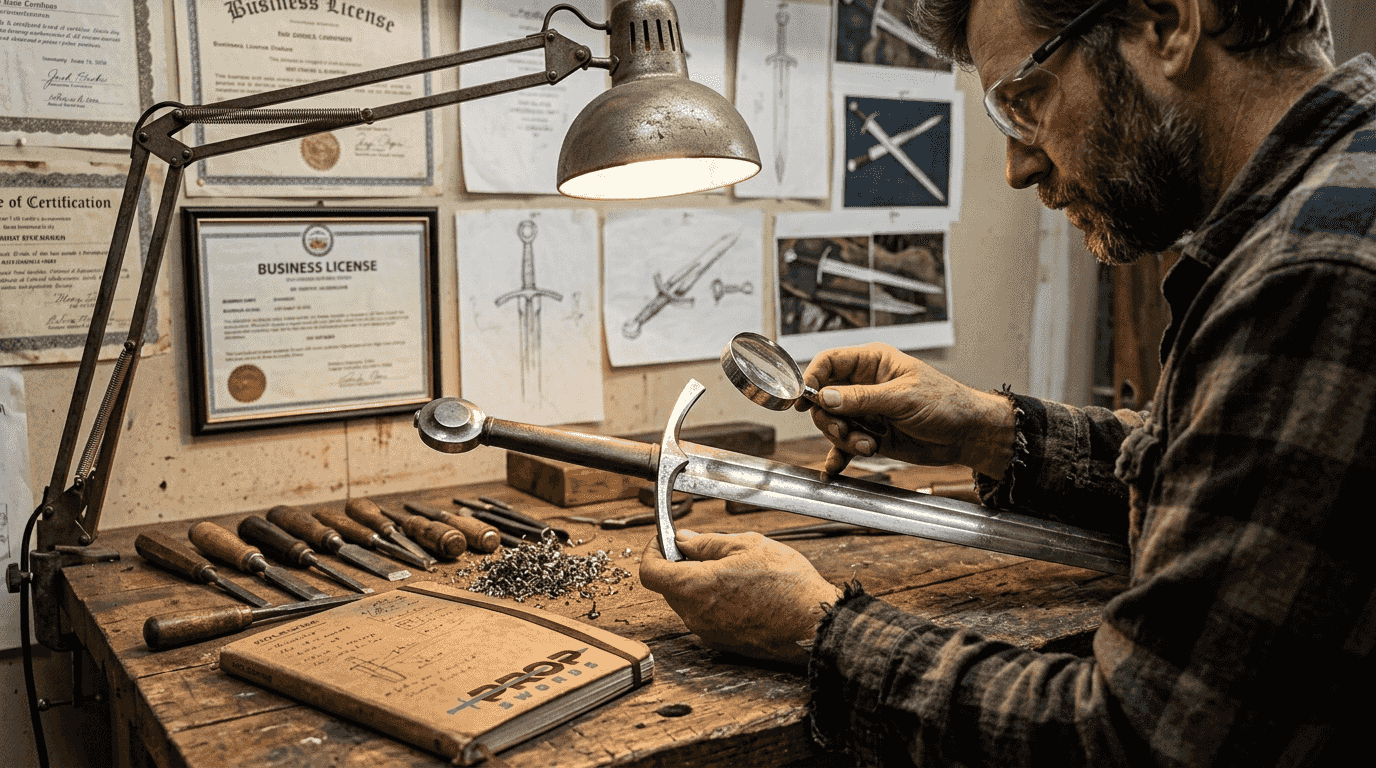
Production time for a simple one-handed or long sword was around one week, including all finishing steps, a timeline that quality reproduction makers still respect when creating historically faithful pieces. Rushing this process inevitably compromises quality, whether through inadequate heat treatment, poor fitting of components, or insufficient attention to balance and handling characteristics.
The sword production process follows these essential stages:
- Initial forging or stock removal to establish basic blade shape and profile
- Heat treatment cycles including normalization, hardening, and tempering
- Grinding and profiling to achieve proper blade geometry and edge bevels
- Guard and pommel fitting, ensuring tight tolerances and historical accuracy
- Handle construction using period-appropriate materials and wrapping techniques
- Final polishing, sharpening, and quality inspection before delivery
Handle construction particularly impacts safety, as improper tang peening or inadequate epoxy bonding can allow components to separate during use, creating dangerous projectiles. Historical swords used hot peening to mechanically lock pommels onto tangs, a technique that quality reproduction makers still employ despite the additional time and skill required. Modern adhesives supplement rather than replace mechanical fitting in the best reproductions.
Modern legal considerations add another layer of complexity. Many jurisdictions restrict blade lengths, edge sharpness, or public carry of swords, forcing makers to offer different versions for different markets. Some reproductions ship with blunt edges that owners can sharpen themselves, while others remain permanently unsharpened to comply with local regulations. These compromises sometimes conflict with historical accuracy, as authentic medieval swords were obviously sharp and ready for combat.
Pro Tip: Before purchasing a reproduction for reenactment or cutting practice, verify the tang construction. Full tang pieces where you can see the steel extending to the pommel offer far greater safety and durability than rat-tail tangs or threaded construction, regardless of how authentic the exterior appears.
Understanding how movie sword replicas quality safety standards differ from historical reproductions helps collectors set appropriate expectations, as Hollywood props prioritize actor safety and visual impact over historical fighting characteristics.
Identifying authentic historical reproductions and spotting fakes
The reproduction sword market spans from meticulously researched museum-quality pieces to crude fakes designed to deceive uninformed buyers. The quality of reproduction swords varies, with some manufacturers striving for historical accuracy while others produce items easily identifiable as fakes to educated collectors. Developing the ability to distinguish between these extremes protects your investment and ensures your collection contains pieces worthy of display and study.
Blade etching provides one of the clearest indicators of quality and authenticity. Hand-engraved inscriptions show slight variations in depth and width, with crisp edges that catch light distinctly. Machine-etched or acid-etched markings appear uniformly shallow with rounded edges, often accompanied by a slightly roughened surface texture. Fakers frequently apply incorrect inscriptions or maker’s marks from wrong time periods, mixing Viking-era runes with Renaissance-style flourishes in ways that would never appear on historical pieces.
Several methods can identify reproduction swords, including examining details like the guard, blade etching, and the presence of incorrect markings that reveal mass production shortcuts. Guard construction deserves particular scrutiny, as historical guards were forge-fitted to blades with tight tolerances, while cheap reproductions often show gaps filled with epoxy or feature guards that spin loosely on the tang.
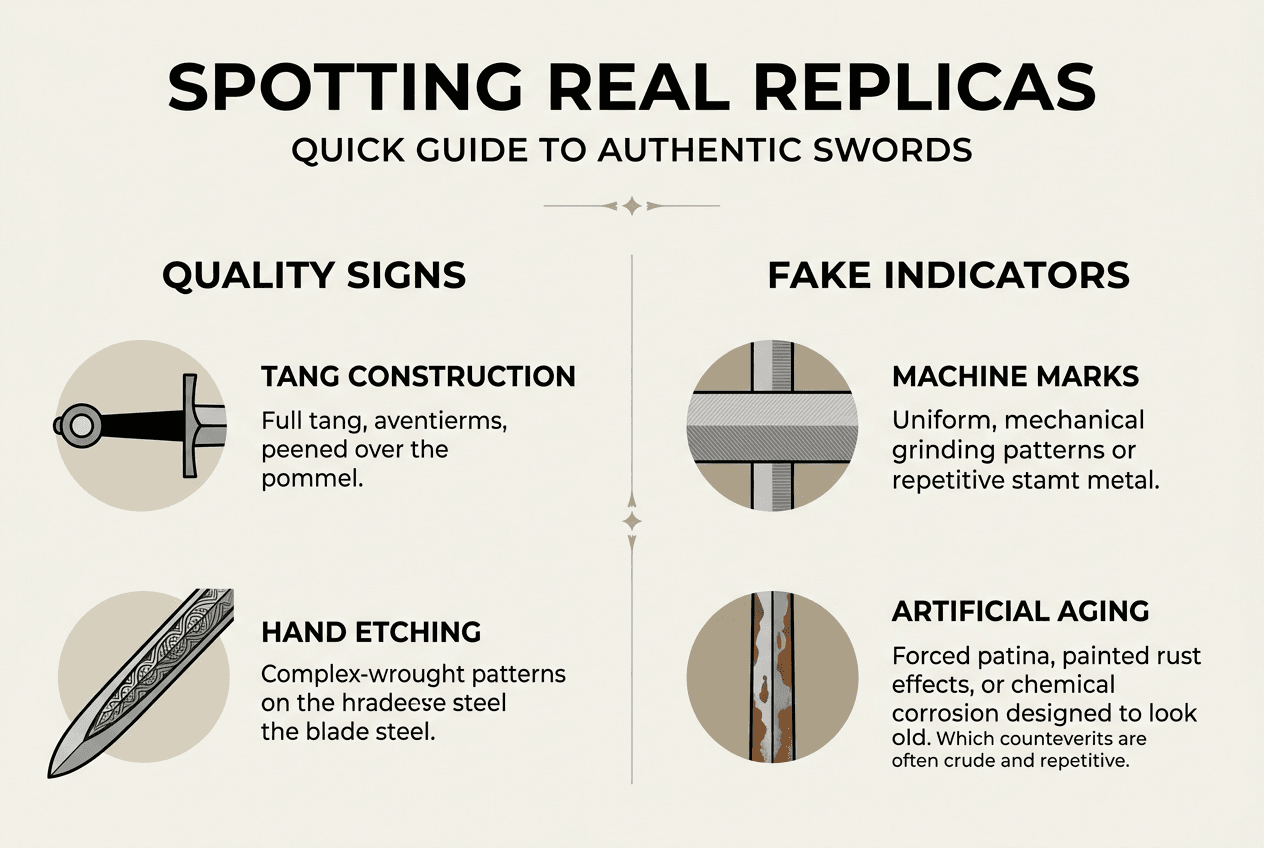
Artificially aged swords represent a particularly deceptive category, where makers apply chemical patinas, deliberate pitting, or false wear patterns to suggest age and authenticity. Genuine antique swords show wear patterns consistent with actual use and storage, with edge damage concentrated in areas that would contact opponents’ weapons or scabbards. Fake aging often appears too uniform or shows corrosion in protected areas that would remain pristine on real pieces.
| Feature | Quality Reproduction | Mass-Produced Fake |
|---|---|---|
| Blade etching | Hand-engraved with crisp edges and period-accurate inscriptions | Machine-etched with rounded edges, often anachronistic markings |
| Guard fitting | Forge-fitted with tight tolerances, no visible gaps | Loose fitting with epoxy gaps, may rotate on tang |
| Weight distribution | Balanced at or near guard, handles naturally | Blade-heavy or pommel-heavy, awkward in hand |
| Tang construction | Full tang visible at pommel, hot-peened securely | Hidden rat-tail or threaded tang, often loose |
| Surface finish | Consistent with hand-forging marks or period grinding | Obvious machine marks or unrealistic “aging” |
Critical details to examine when evaluating reproductions:
- Pommel attachment method and whether peening shows appropriate mushrooming
- Blade fuller depth and symmetry, as hand-forged fullers show subtle variations
- Handle material authenticity, particularly leather quality and wrapping technique
- Overall proportions compared to museum examples from the claimed period
- Maker’s reputation and willingness to discuss construction methods transparently
Collectors should request detailed photographs showing tang construction, close-ups of any inscriptions or markings, and multiple angles of guard and pommel fitting before purchasing significant pieces. Reputable makers gladly provide this documentation and often include certificates detailing materials, techniques, and historical research supporting their reproductions. Reluctance to provide such information or vague descriptions of construction methods signal potential problems.
Learning to authenticate replica swords requires studying both historical examples and common faker techniques, building visual literacy that protects against increasingly sophisticated forgeries entering the market.
Pro Tip: Join collector forums and attend arms and armor shows to handle both quality reproductions and obvious fakes in person. This tactile experience teaches you weight distribution, balance, and construction quality far more effectively than photographs alone, building intuition that protects future purchases.
Explore high-quality historical sword reproductions
Finding reproductions that honor historical craftsmanship while meeting modern quality standards requires connecting with makers and retailers who share your passion for authenticity. Propswords offers carefully curated selections of historical reproductions alongside fantasy and entertainment-inspired pieces, providing collectors with options spanning multiple interests and price points. Whether you’re seeking Viking-era swords for reenactment, medieval longswords for display, or Japanese katana reproductions for martial arts practice, working with knowledgeable retailers ensures you receive pieces built to appropriate standards.

The commitment to craftsmanship and historical research distinguishes quality retailers from mass-market sellers pushing generic “medieval swords” with no connection to actual historical designs. Explore collections that provide detailed specifications, material information, and clear explanations of intended use, whether decorative, functional, or combat-ready. This transparency helps you make informed decisions aligned with your collecting goals and budget, building a collection that grows in both size and sophistication over time.
FAQ
What materials are most authentic for historical sword reproductions?
High carbon steels containing 0.6% to 1.0% carbon provide the most historically accurate material for blade reproduction, closely matching the properties of ancient bloomery iron and early crucible steels. Layered Damascus steel offers both visual appeal and structural benefits when makers follow traditional pattern-welding techniques. Modern substitutes like 5160 spring steel or 1095 carbon steel balance historical accuracy with consistent performance and availability. Handle materials should include wood, leather, and bronze or iron fittings rather than modern synthetics to maintain period authenticity.
How can I tell if a historical sword reproduction is a high-quality replica or a fake?
Examine blade etching for hand-engraved crispness versus machine-etched uniformity, as quality reproductions show slight variations consistent with traditional methods. Check guard fitting for tight tolerances without epoxy gaps, and verify full tang construction by examining pommel attachment. Authenticating replica swords requires comparing proportions and details against museum examples from the claimed period. Weight distribution and balance provide immediate tactile feedback, as quality pieces handle naturally while fakes feel awkward or blade-heavy due to poor design.
Why do reproductions vary so much in price and quality?
Quality depends fundamentally on research depth, material selection, craftsman skill level, and production time invested in each piece. Cheaper replicas cut corners on heat treatment, use lower-grade steels, and employ purely decorative construction unsuitable for any functional use. Sword craftsmanship and quality reflect the maker’s commitment to historical accuracy versus profit maximization through mass production. A week of skilled labor for a single sword versus factory production of dozens daily explains price differences ranging from under $100 to several thousand dollars for museum-quality reproductions.
Are reproduction swords legal to own and display?
Legality varies significantly by jurisdiction, with some regions restricting blade length, edge sharpness, or requiring specific storage and transport methods. Most locations permit ownership of swords within private residences for collecting purposes, but public carry or concealment faces strict regulation. Research local and national laws before purchasing, particularly for sharpened or combat-ready reproductions. Some retailers offer jurisdiction-specific versions with compliant blade lengths or permanently blunted edges to satisfy legal requirements while maintaining display quality.
How should I care for and maintain a historical sword reproduction?
Store reproductions in climate-controlled environments with stable humidity to prevent rust and corrosion, particularly for high-carbon steel blades. Apply thin coats of mineral oil or specialized sword care products every few months, wiping away excess to prevent dust accumulation. Avoid touching blades with bare hands, as skin oils promote corrosion even on stainless steel. For combat-ready pieces used in cutting or sparring, inspect regularly for stress cracks, loose fittings, or edge damage requiring professional attention. Proper maintenance preserves both appearance and structural integrity across decades of ownership.